
Key takeaways
- General web directories are dead weight. Yahoo Directory closed in 2014, DMOZ in 2017, and Google’s spam policies list low-quality directory links as link spam.
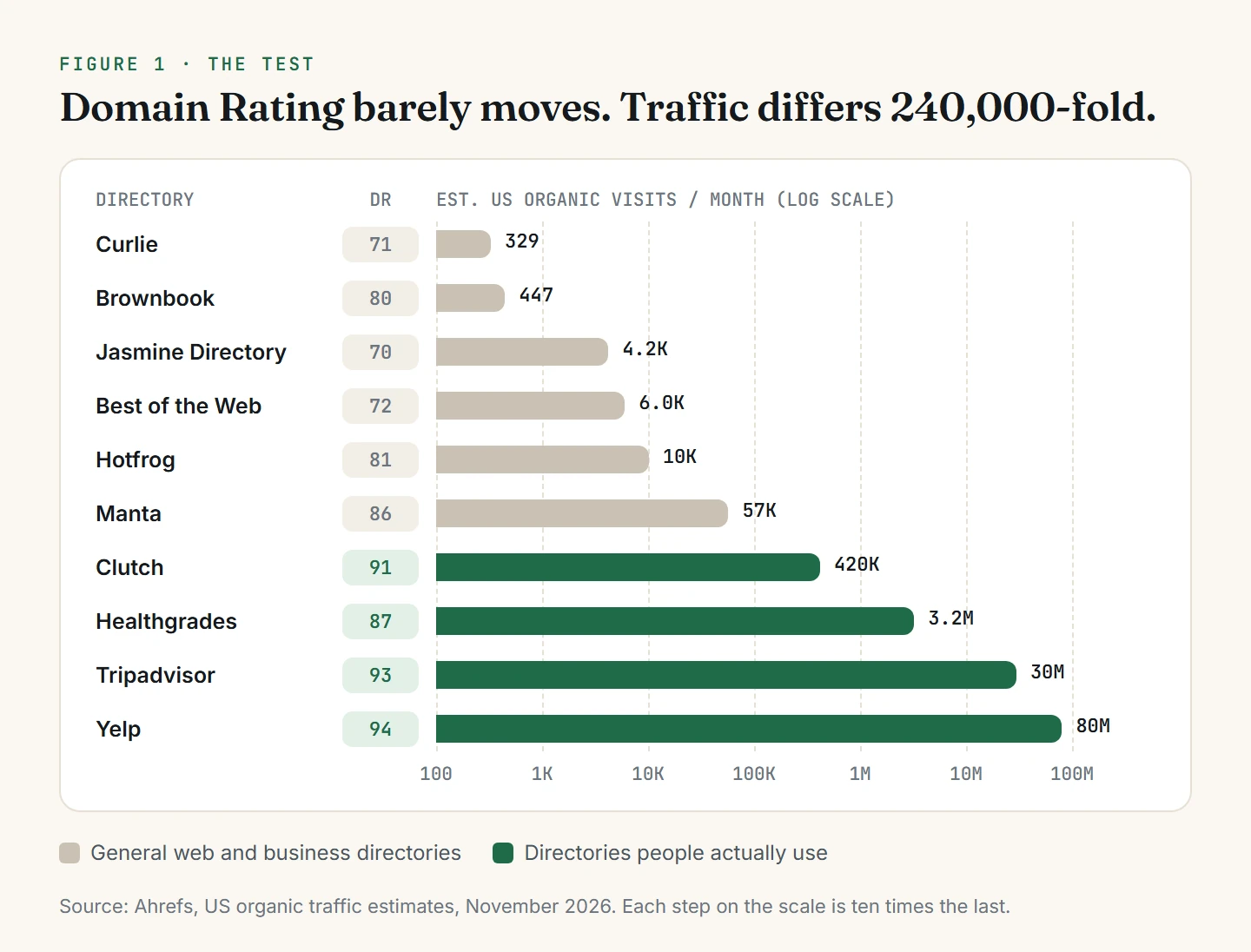
- Judge a directory by its traffic, not its DR. Brownbook (DR 80) gets about 450 US visits a month; Yelp (DR 94) gets about 80 million.
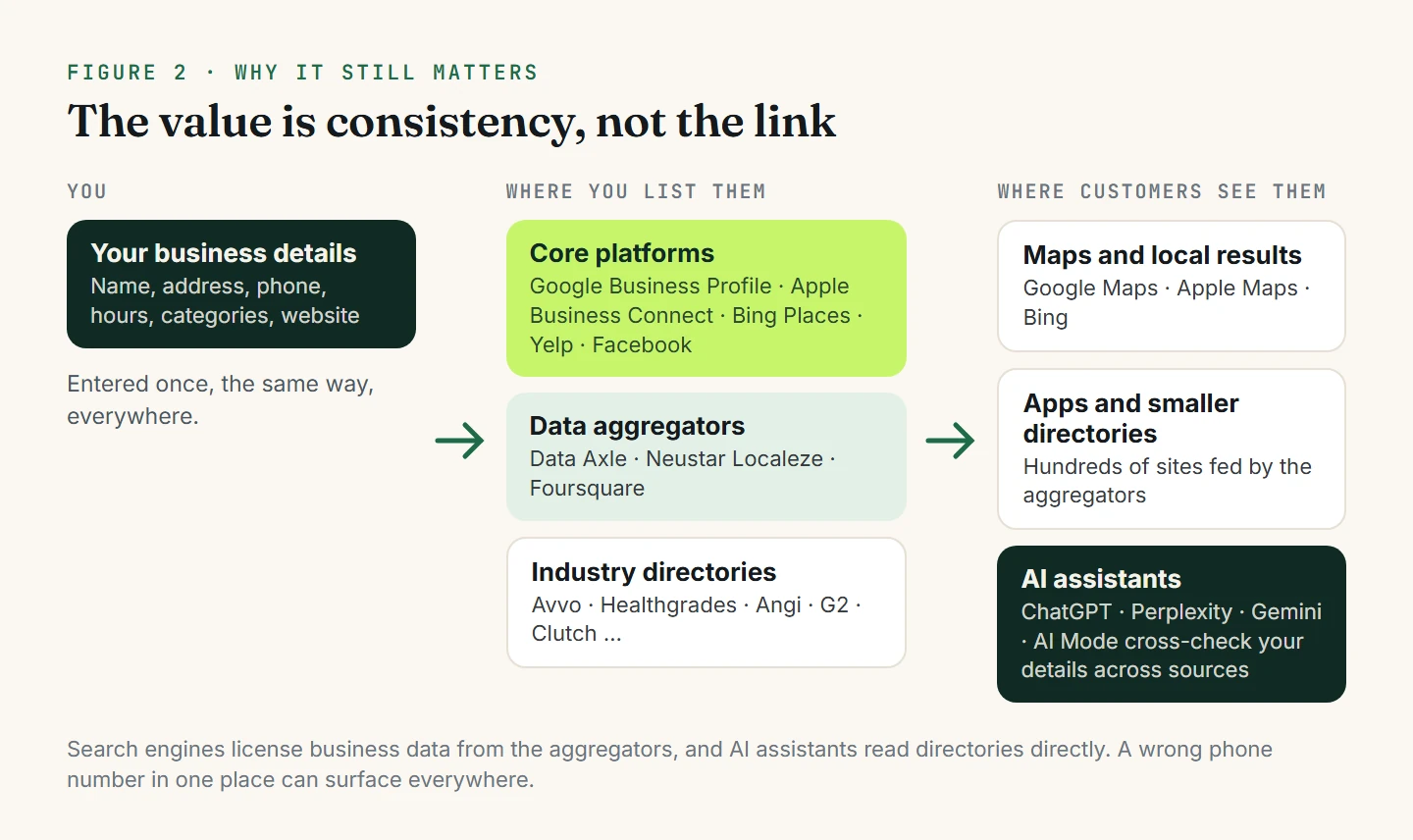
- Local businesses still need the core platforms. Google Business Profile, Apple Business Connect, Bing Places, Yelp and the data aggregators keep your details consistent across maps and AI assistants.
- List where your buyers browse. Industry directories such as Avvo, Healthgrades, G2 or Clutch send real visitors and increasingly feed ChatGPT’s answers.
- In iGaming, skip “casino directories”. Operators belong in regulator registers and player complaint platforms; affiliates join networks like the GPWA for partnerships, not links.
Short answer: general web directories are not worth your time in 2026. A few kinds of directory are: the platforms that feed maps and AI assistants, the directories your buyers actually browse, and a handful of trust signals. The test that separates them is simple, and it is not Domain Rating.
In this article
Where this page came from
This URL has a history. In October 2011, long before I owned the domain, it hosted a “List of Free Directories”: more than 1,300 general web directories that would take your link for free. It was popular enough that in 2012 Moz used it as one of the source lists for a study of 2,678 directories. That study found 94 directories (3.5%) already removed from Google’s index and another 417 (15.6%) penalized, roughly one in five.
That was 14 years ago, and it was already the beginning of the end. Rebuilding the old list would be a disservice to anyone who lands here. This page is what I would tell a client who asks whether directories are still worth doing.
What happened to web directories
Three things happened.
- The big curated directories closed. Yahoo Directory shut down at the end of 2014. DMOZ, the volunteer-edited Open Directory Project, closed in March 2017. Its successor, Curlie, still exists, but it gets almost no search traffic (more on that below).
- Google named the tactic as spam. Google’s spam policies list “low-quality directory or bookmark site links” as an example of link spam. In 2021 John Mueller said directory submissions, article submissions and bookmarking links are generally against Google’s guidelines.
- Search moved to platforms. People looking for a plumber, a lawyer or a project management tool now search Google Maps, Yelp, G2 or an AI assistant, not a directory of websites.
The word “directory” survived, but what it means changed. The ones that matter today are platforms with their own audience, not link lists.
The test: traffic, not authority
Most “best directory submission sites” lists sort by Domain Rating or Domain Authority. That is the wrong metric. DR measures a site’s backlink profile. It says nothing about whether anyone uses the site, or whether Google trusts the pages your listing would sit on.
Here are a few general business and web directories that still appear on those lists, with Ahrefs’ US organic traffic estimates (November 2026):
| Directory | Domain Rating | Est. US organic visits/month |
|---|---|---|
| Brownbook | 80 | ~450 |
| Curlie (DMOZ successor) | 71 | ~330 |
| Best of the Web | 72 | ~6,000 |
| Jasmine Directory | 70 | ~4,200 |
| EZlocal | 80 | ~8,100 |
| Hotfrog | 81 | ~10,100 |
| Manta | 86 | ~57,000 |
Now compare directories that people actually use:
| Directory | Domain Rating | Est. US organic visits/month |
|---|---|---|
| Yelp | 94 | ~80 million |
| Tripadvisor | 93 | ~30 million |
| MapQuest | 91 | ~10 million |
| Healthgrades | 87 | ~3.2 million |
| Better Business Bureau | 93 | ~3.2 million |
| Justia | 91 | ~2.6 million |
| Houzz | 92 | ~1.6 million |
| G2 | 91 | ~620,000 |
| Clutch | 91 | ~420,000 |
Brownbook and Yelp sit ten DR points apart. Their traffic is about 180,000 times apart. A listing on a page that nobody visits and Google barely ranks does nothing for you, whatever the DR says.
Directories that are still worth it
1. The platforms behind maps and AI answers (if you serve customers locally)
If you have a physical location or a service area, these are not optional:
- Google Business Profile: the listing behind Google Maps and the local pack.
- Apple Business Connect: controls how you appear in Apple Maps and Siri.
- Bing Places: feeds Bing and Microsoft’s assistants.
- Yelp: in BrightLocal’s 2025 test of four AI search tools, Yelp was a source in 33% of local searches, and Perplexity used it in every industry tested.
- Facebook and Foursquare, which many apps and data providers read from.
Behind these sit the data aggregators, companies that license business data to maps, apps and search engines. In the US the main ones are Data Axle (formerly Infogroup), Neustar Localeze and Foursquare (which absorbed Factual in 2020). Getting your name, address and phone number right at the aggregator level fixes errors in hundreds of downstream sites you will never touch by hand.
The value here is not the link. It is consistency: maps and AI assistants cross-check your details across sources before they trust them.
2. The directories your buyers browse
Every industry has two or three directories that customers actually use to compare options. These send real visitors, and they increasingly feed AI answers. In BrightLocal’s 2025 study, ChatGPT drew answers for dentist searches exclusively from ten dental directories, and relied heavily on Super Lawyers and FindLaw for legal queries.
| Industry | Directories worth a listing |
|---|---|
| Legal | Avvo, Justia, FindLaw, Super Lawyers |
| Medical and dental | Healthgrades, Zocdoc, plus your specialty’s directory |
| Home services | Angi, Thumbtack, Houzz |
| Travel and hospitality | Tripadvisor |
| B2B software | G2, Capterra |
| Agencies and consultants | Clutch, DesignRush, GoodFirms |
| Startups and new products | Crunchbase, Product Hunt, AlternativeTo |
If your industry is not on this list, find its equivalents: search for your service the way a customer would and note which directories keep appearing on page one.
3. Trust and membership directories
Some listings matter because of who vouches for you, not because of traffic:
- Better Business Bureau in the US, still widely cited by both people and AI tools.
- Your chamber of commerce and local business associations.
- Professional bodies and associations in your field.
- University, alumni and supplier directories, where a link is earned by an actual relationship.
These links are editorial in the sense Google cares about: someone had to accept you.
4. The “best of” lists AI assistants read
This is the newest category, and the strangest. In BrightLocal’s study of 800 ChatGPT local searches (November 2024), directories made up 15% of all sources, and two sites dominated: Three Best Rated (24% of directory citations) and Expertise (18%). Both have a DR in the 80s and only around 22,000 estimated US visits a month each.
By the traffic test above, they would fail. For AI visibility, they matter. They are curated lists rather than open directories, so check how each one selects businesses before you count on being included.
Directories for iGaming sites
iGaming is where directory spam is at its worst. “Casino directories” and gambling link lists are mostly link-selling operations, and gambling search results get some of the closest scrutiny from Google’s spam systems. The directories that do matter in this niche look very different from the ones above, and they differ for operators and for affiliates.
If you run a casino or sportsbook
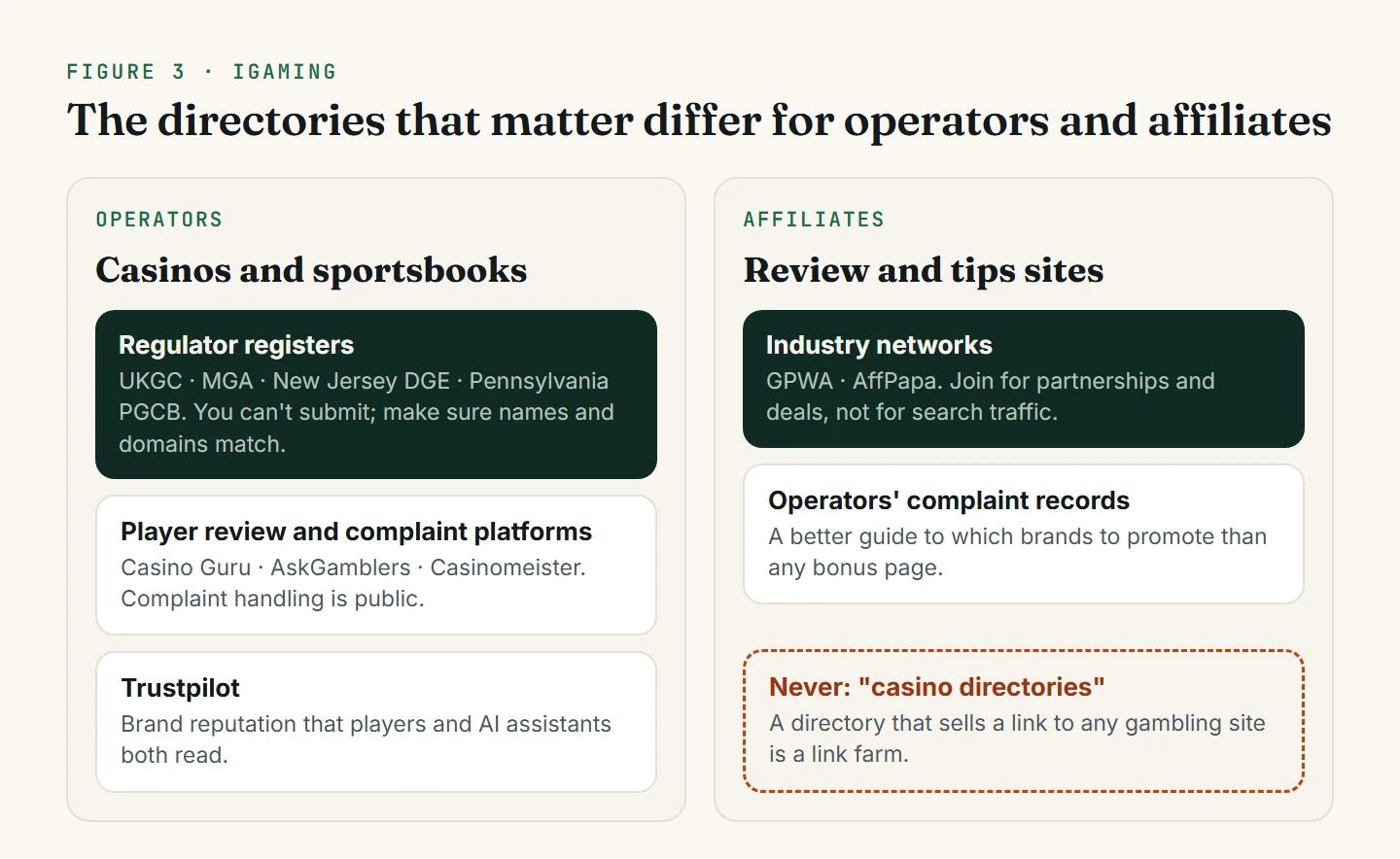
- Regulator registers. The licence lookup is the most important directory an operator is in. The UK Gambling Commission’s public register, the Malta Gaming Authority’s licensee register and US state lists, such as New Jersey’s approved internet gaming sites or the Pennsylvania Gaming Control Board’s, are where players and review sites go to check a licence. You cannot submit to them. You can make sure the brand names and domains they list match your site exactly.
- Player review and complaint platforms. Casino Guru (about 1.4 million estimated organic visits a month worldwide), AskGamblers (about 900,000) and Casinomeister (about 290,000) are where players check an operator before they deposit. Casino Guru and AskGamblers both run complaint services, and how you handle complaints there is visible to everyone. Check the geography: most of Casino Guru’s and AskGamblers’ search traffic comes from Germany, while Casinomeister’s comes mainly from the US and UK.
- Trustpilot, which players and AI assistants both read for brand reputation.
- The local platforms, if you also have retail sportsbooks or land-based venues. Everything in section 1 applies.
If you run an affiliate site
- Industry associations and B2B directories. The GPWA (Gambling Portal Webmasters Association) is a long-running membership association for gambling affiliates, and AffPapa is a directory that connects affiliates and operators. Their value is partnerships and deals, not search traffic: Ahrefs estimates about 7,500 organic visits a month for GPWA and about 700 for AffPapa. Join them for the network, not the link.
- The operator-side platforms above. Affiliates benefit from them too. A complaint record on Casino Guru or AskGamblers is a better signal of whether a brand is worth promoting than any bonus page.
What iGaming sites should never do is buy listings on “casino directories” or “gambling link lists”. In this niche, a directory that sells a link to anyone with a casino site is not a directory. It is a link farm.
What to skip
- General web directories that accept any site in any category.
- “Free directory submission sites” lists with hundreds of entries. If a list has 300 directories, at most a handful are worth anything.
- Paid “dofollow” listings sold for their link value, if they don’t match the context of your site or do not link to your page in a natural way.
- Directories that require a link back to them.
- Bulk submission services that promise 500 listings for a flat fee.
Check any directory in five minutes
- Search like a customer. Type your service and city, or your product category, into Google. Does the directory appear on page one? If it never does, nobody finds you through it.
- Check its traffic, not its DR. Use Ahrefs, Semrush or a similar tool to see how much organic traffic it gets and from which country.
- Look at a listing page like yours. Is it indexed (search for its exact URL), does it rank for anything, and does it have real content beyond a name and a link?
- Look for an editorial filter. A directory that rejects listings, verifies businesses or charges for review is a better signal than one that accepts everything.
- Ask whether a customer would use it. If you would not show the listing to a client, it is not helping you.
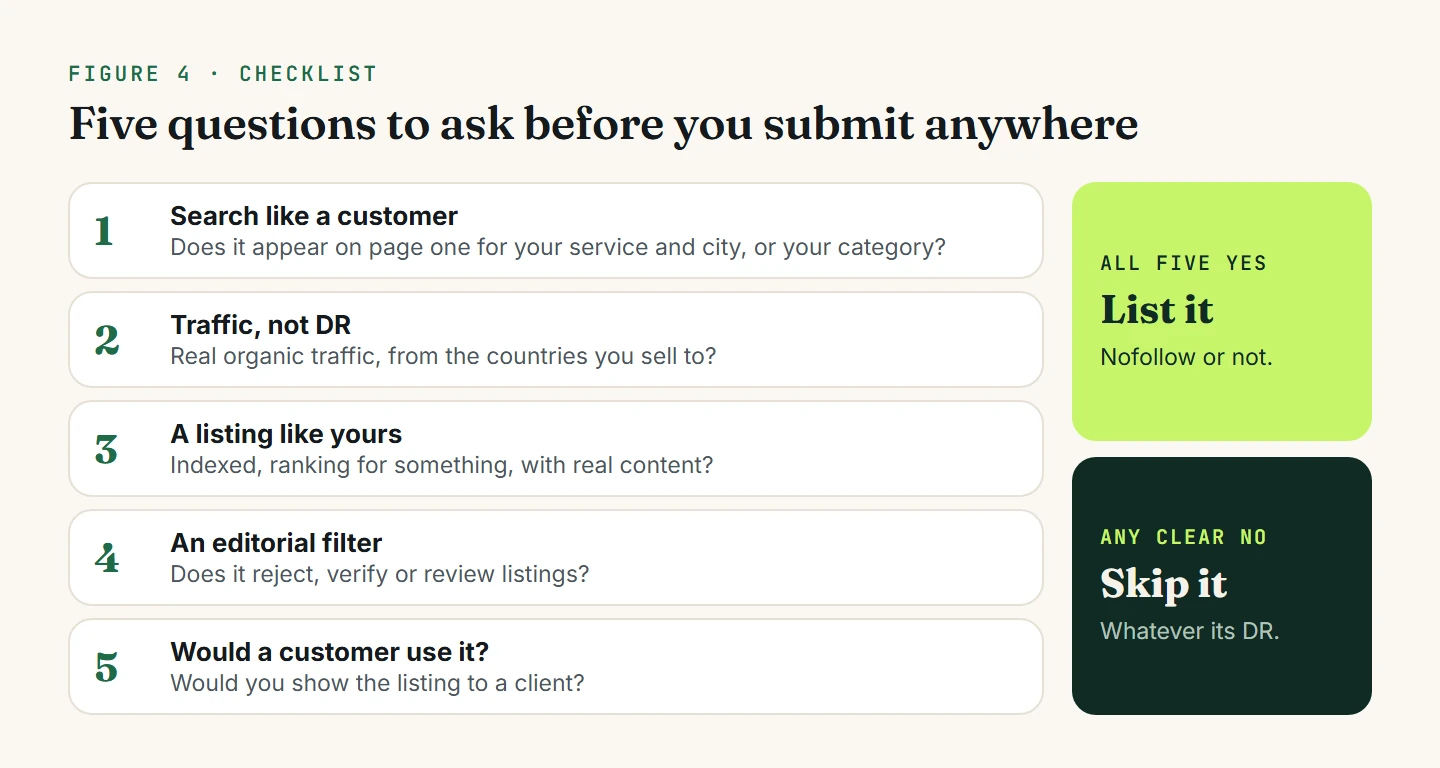
A note on nofollow: many of the best directories (Yelp, G2, Clutch) nofollow their outbound links. That is fine. You are there for customers, citations and AI visibility, not PageRank.
FAQ
Is directory submission still a valid SEO tactic?
Mass submission is not. Google classes low-quality directory links as link spam. Listing your business on the platforms and industry directories your customers use is still worth doing, but it is business listing management, not link building.
Do directory backlinks help rankings?
Rarely, and not because of the link. A listing on a well-used directory can help local rankings through citation consistency, and it can get you mentioned in AI answers.
How many directories should a small business be listed in?
Fewer than you think. For a typical local business: the five or six core platforms, the main data aggregators, two or three industry directories and any membership directories you qualify for. Accuracy across those beats being everywhere.
Are there directories worth it for casino and betting sites?
Yes, but not the ones that sell “casino directory” links. For operators, the ones that count are regulator registers and player review platforms such as Casino Guru, AskGamblers and Casinomeister. For affiliates, they are industry networks such as the GPWA and AffPapa, valuable for partnerships rather than SEO.
Are paid directories worth it?
Only if the directory sends verifiable referral traffic or leads, and your buyers really browse it. Pay for the audience, never for the link.